
So, since starting this guitar blog, I have addressed the topic of ‘sounding good.” In the April blog, titled “You Don’t Have To Have An Expensive Guitar To Sound Good,” I talked a bit about finding a good quality guitar, even mid-priced, and having a reputable guitar tech do a proper setup. In the May blog, I addressed the topic of fingernails and fingernail care to produce a pleasing tone. I also mentioned last month I would address technique, which is paramount to one’s playing, and sound.
Well, this month I will give you the first installment of a three part series regarding technique. Now, please indulge me for a minute while I give you my take on technique. Many people think that technique is the ability to play difficult music, or to play fast, and that players of an advanced level are the only ones who have “good technique.” Not so. Having good technique is the ability to play well at any level, even a beginner. It is also the ability to play with minimal tension, and efficient movement. So, even if you have just begun, and have only learned a G-Em-C-D chord progression, but can change in time with minimal finger movement and tension, you have developed good technique. I have many beginner students who play well at their current level. They are developing proper habits that will enable them to move on to more advanced repertoire, all the while, playing with good technique.
So, now that that is out of the way, the first step to good technique is to examine how you sit with the guitar.
What? Seating position? What does that have to do with technique?
Over the years, I have found in my own playing, and that of my students, that many technical problems can be improved or solved when the guitar is properly placed in front of us. That’s right, sometimes it’s nothing more than re-examining how we hold the instrument. As a former classical guitarist, I spent years studying and applying concepts of proper seating position, and now, as a fingerstyle guitarist, I apply the same principals. I even apply many of these concepts when I’m casually strumming (more on that later).
Many guitarists use the tried and true method of placing the guitar on their right leg, with the neck remaining more or less level. And, for many, this works fine. Myself, I prefer to have the neck angled so the headstock is just about at eye level.

This positioning has many advantages:
By raising the guitar, I now can keep my back straight and head up, avoiding any unwanted tension that occurs from bending over to reach the guitar.
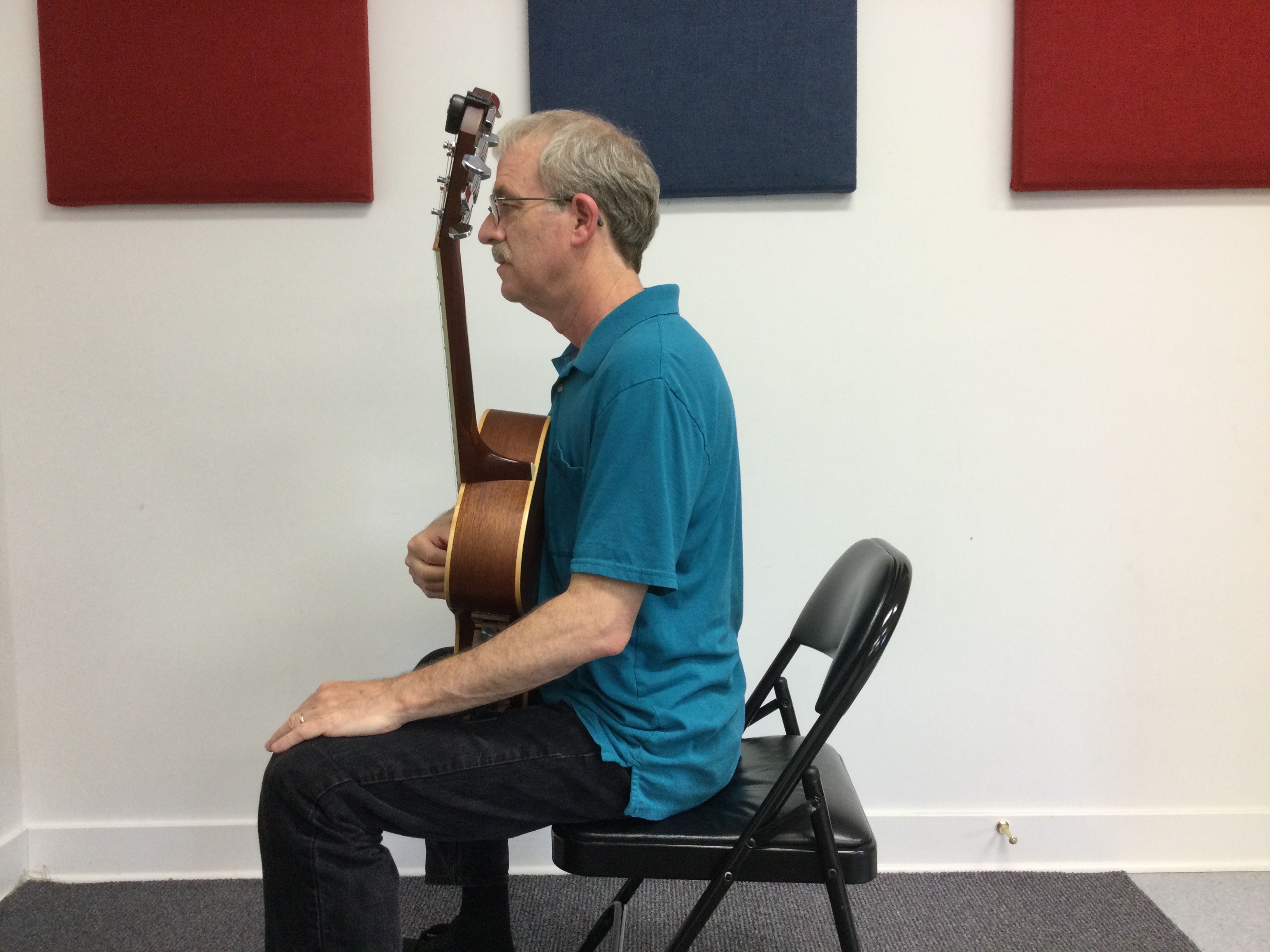
Back straight/head up

Back twisted/head hunched over
2. I now am raising my left hand to the neck, keeping my wrist straight.
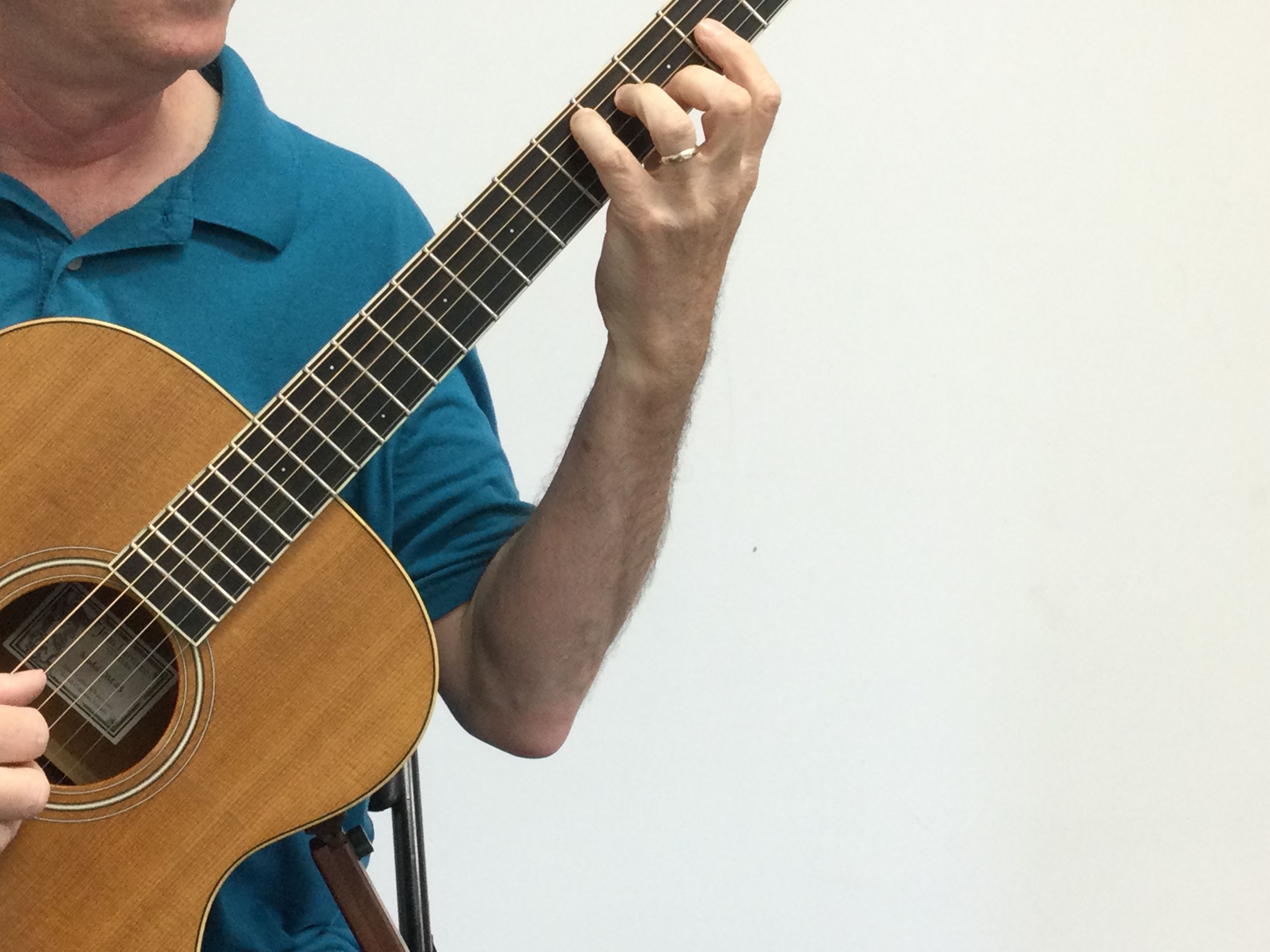
This helps me avoid any unwanted tension from flexing the wrist too much.
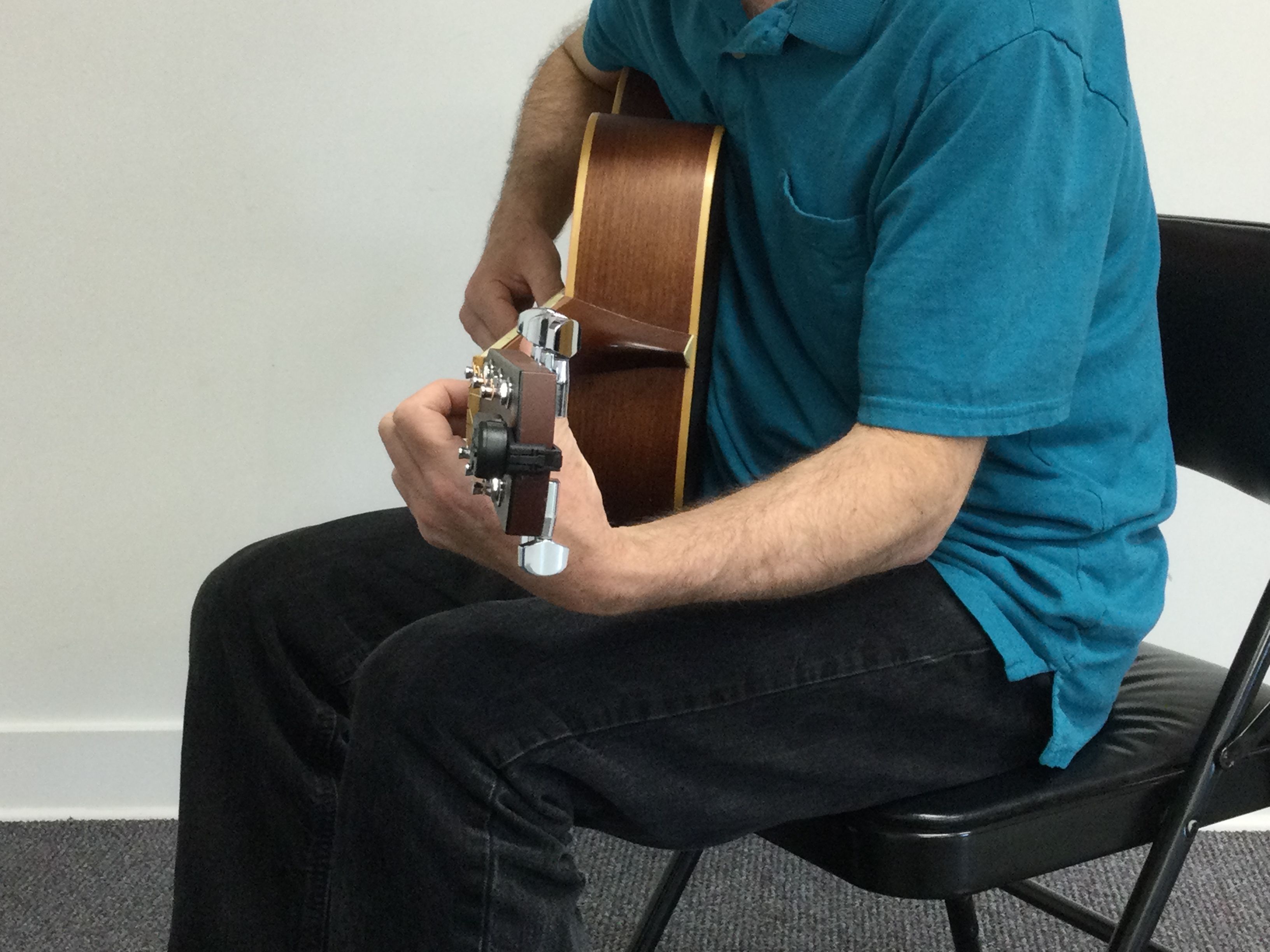
Keeping my wrist straight allows all the tendons in my left arm to work in a straight line, rather than around a corner. This is much more relaxed and efficient. It also allows my left hand to expand its reach.
3. This position also allows my left hand to reach both ends of the neck without twisting my body.
4. I now have more room to comfortably move my right hand fingers. I can also keep my right wrist straight as well, which is more relaxed.
You can see from the photos above that I use a guitar support to help with positioning. Some players prefer an adjustable footstool. I found the footstool didn’t work for me. The concept is to find a relaxed position for your body, then adjust the guitar to that, rather than adjust your body to the guitar.
There are many makes and models of guitar supports, and you can find them online at places such as Amazon. I purchased mine from Strings By Mail, and if you want to check out their selection of guitar supports, click here.
Maybe all you want to do is casually sit snd strum. No problem! I spend a lot of time doing this, especially when I’m teaching. You can still sit with the guitar on your right leg. Just try and get the instrument to sit higher, and angle the neck as much as you can so you can keep your left wrist straight. Many times I use an adjustable footstool to rest my right foot upon.
To sum things up, keeping as much tension out of your hands and body is paramount to playing well. Twisting your body into a pretzel (which I am just as guilty of sometimes) just isn’t going to do the job. Whatever you decide to do, just remember - being a more relaxed player is much more fun and will allow you to progress to levels of playing that may have seemed beyond your reach.
If you have any questions or want advice, just reach out to me on my Contact page.
Here’s to a more relaxed you!